Mar 12, 2026
Anatole
Paty
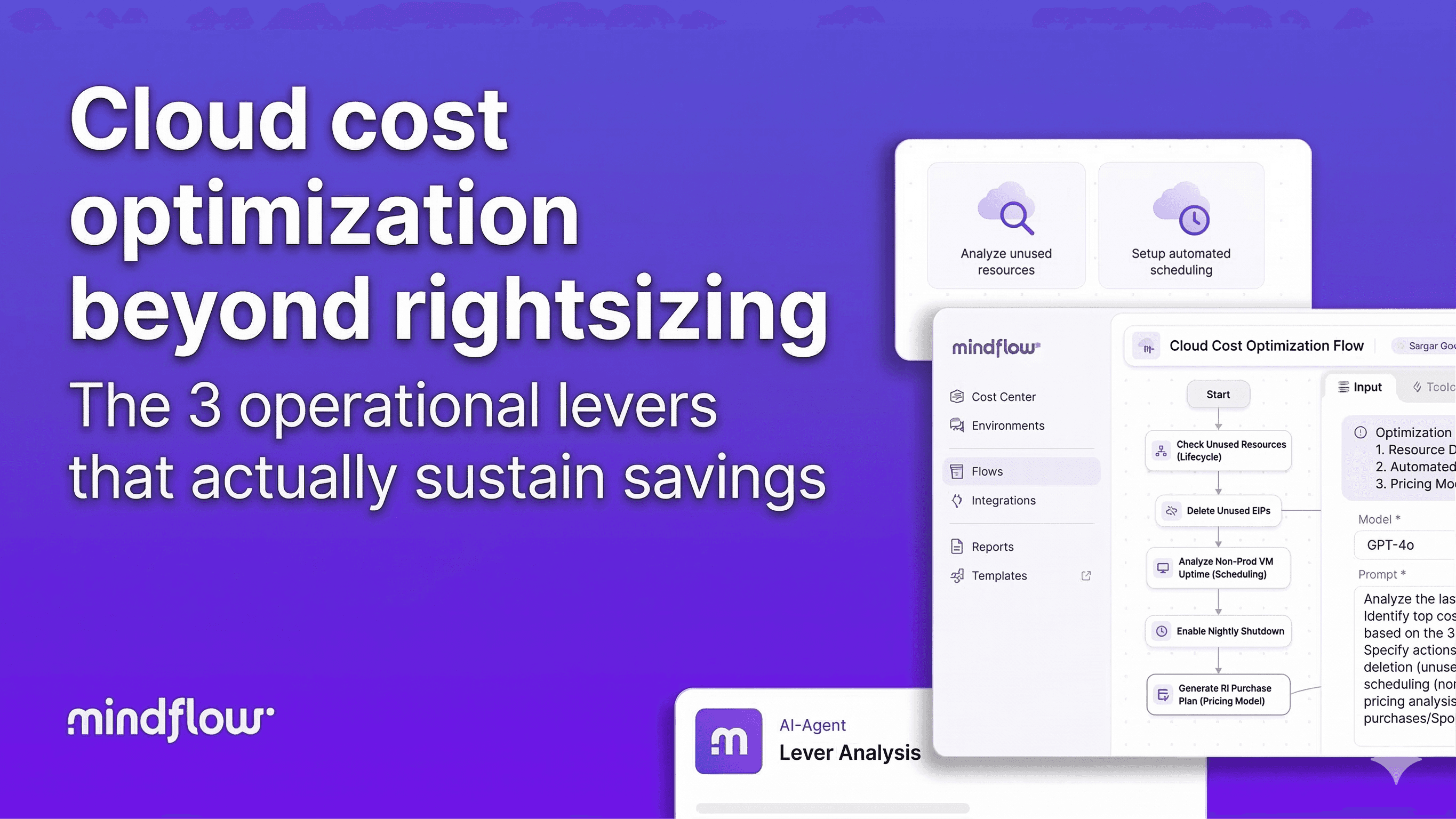
Your team completed a comprehensive rightsizing audit last quarter. Instance types were optimized, unused resources were terminated, and the monthly bill dropped 18%. Three months later, spending is back where it started. The CFO wants to know why the savings disappeared, and your answer—"teams are shipping faster now"—doesn't help.
This pattern repeats across enterprises because organizations treat cloud cost optimization as a completed infrastructure audit rather than an operational discipline. Sustained 25-60% savings require embedding cost controls into engineering workflows through three mechanisms: automated policy enforcement, explicit ownership mapping, and cost-performance observability. Research from large-scale healthcare implementations demonstrates this approach (Natarajan Swarnaras, International Journal of Computational and Experimental Science and Engineering, 2026). The framework is not about adding a FinOps team to police spending. It is about engineering systems where cost-efficient defaults are automatic and exceptions trigger alerts when they occur.
TL;DR
Rightsizing delivers 15-20% initial savings, but cost drift resumes within 3-6 months without continuous governance mechanisms
Sustained optimization requires policy-as-code that blocks non-compliant deployments, team-level budget ownership, and cost metrics integrated into developer dashboards
Commitment-based pricing (Reserved Instances, Savings Plans) works when covering 60-70% of proven baseline demand with incremental terms, not forecasted growth with 3-year locks
Autoscaling implementations scale up reliably but often fail to scale down aggressively, while storage lifecycle management delivers 40-70% savings on data-heavy workloads most teams ignore
Why Rightsizing Alone Loses Momentum After 90 Days
The typical optimization cycle follows a predictable arc. Infrastructure teams audit resource utilization, downsize overprovisioned instances, and eliminate zombie resources. The bill drops 15-20% immediately. Executives celebrate. Then quarterly reviews show costs climbing back toward pre-optimization levels.
This happens because rightsizing is a point-in-time adjustment, not a continuous process. Without enforcement mechanisms, teams prioritize feature velocity over cost discipline. New services launch with default configurations. Autoscaling policies drift toward overprovisioning. Storage accumulates without lifecycle rules. Research shows that embedding cost optimization into routine operations through automated checkpoints and recurring reviews delivers sustained savings, not one-time resource adjustments (Natarajan Swarnaras, 2026).
A healthcare enterprise completed comprehensive rightsizing that saved 18% in Month 1. By Month 4, spending returned to previous levels. The failure was not technical. The rightsizing recommendations were sound. The failure was operational: no system existed to prevent cost drift as engineering teams shipped new features. Manual recurring reviews scheduled quarterly could not keep pace with weekly deployment cadence.
The gap between initial savings and sustained savings is not a discipline problem. It is a system design problem that requires operational integration, not better intentions.
The Three Operational Mechanisms That Sustain Cloud Cost Optimization
Policy-as-code: Blocking waste before it deploys
Post-deployment cost alerts arrive too late. The resource is running, the spend is committed, and reversing it requires coordination across teams. Policy-as-code enforces cost guardrails at provisioning time, blocking non-compliant deployments before they consume budget.
This means untagged resources rejected in CI/CD pipelines, instance types outside approved categories flagged during pull requests, and budget thresholds validated before infrastructure-as-code applies changes. Research from The AI Journal (2026) shows governance frameworks that enforce policies automatically reduce cloud waste by 30-40% compared to monitoring alone because they prevent expensive mistakes rather than documenting them.
Manual tagging strategies fail because they rely on discipline that erodes under delivery pressure. Automated enforcement makes correct configuration the default path, not an optional best practice.
Explicit cost ownership: Why tagging isn't enough
Tagging strategies sound rational: tag every resource with team, environment, and cost center, then generate chargeback reports. In practice, resources become untagged within months without automated enforcement. Even perfectly tagged resources do not create accountability if teams lack budget ownership and cost visibility.
Effective ownership requires team-level budget allocation with explicit thresholds, cost dashboards integrated into the tools developers use daily, and unit economics that translate cloud spending into business metrics: cost per transaction, cost per user, cost per deployment. Research shows cost ownership must be localized rather than centralized. Each team owns their spending with visibility into how it ties to business outcomes (Natarajan Swarnaras, 2026).
Centralized FinOps teams that approve every deployment create bottlenecks. Fully decentralized spending without guardrails leads to uncontrolled growth. The balance is automated governance with localized accountability.
Cost-performance observability: The missing feedback loop
Separating cost reporting from performance monitoring leads to optimization for one dimension at the expense of the other. Teams reduce spending by degrading latency, or improve performance by ignoring cost impact. Both outcomes fail.
Cost-performance observability integrates spending, resource utilization, and application performance into the same dashboards engineers check daily. This means cost per API request displayed in the same Grafana view as p95 latency, not a separate monthly finance report. Database spending tracks next to query performance metrics. Deployment cost estimates appear in pull request reviews.
An engineering team reduced API response time by 40ms and cut compute cost by 22% during an optimization sprint because cost-per-request surfaced in the same view as latency percentiles. The observability feedback loop enabled engineers to evaluate trade-offs during development, not after monthly bills arrived. Without integrated visibility, one dimension improves while the other degrades invisibly.
When Commitment-Based Pricing Actually Works (And When It Traps You)
Reserved Instances and Savings Plans deliver 10-30% discounts compared to pay-as-you-go pricing, but they require accurate demand forecasting. This is difficult in dynamic environments where workload patterns shift quarterly. Organizations that commit capital based on 90-day usage data often strand spend in unused reservations when requirements change.
The enterprise approach covers 60-70% of baseline demand with commitments while preserving pay-as-you-go flexibility for variable workloads (Natarajan Swarnaras, 2026). This means analyzing usage patterns over 90+ days to identify stable baseline consumption, then layering commitments incrementally with shorter terms before longer locks.
Start with 3-month or 1-year Reserved Instances for proven baseline workloads. Monitor utilization for one renewal cycle. Only then consider 3-year commitments for workloads that show consistent demand. Automated platforms that recommend commitment purchases dynamically based on actual utilization patterns outperform annual planning cycles that lock budgets into outdated forecasts ("Running AI Workloads Is Getting Extremely Expensive," The AI Journal, 2024).
When to stay pay-as-you-go: experimental projects where usage is uncertain, rapid scaling phases where demand curves are unpredictable, and workloads with high variability that do not justify commitment discounts. Preemptible VMs and Spot Instances work better for batch processing and fault-tolerant workloads than reservations that lock capital into guaranteed capacity.
The trap is treating commitments as the primary optimization lever when they are one component in a portfolio approach that includes rightsizing, governance, and continuous adjustment.
The Autoscaling and Storage Levers Most Teams Leave on the Table
Autoscaling implementations scale up reliably. The failure mode is scale-down behavior: clusters that expand during demand spikes but contract slowly or not at all during off-peak periods, leaving capacity underutilized overnight and on weekends.
Demand-aware autoscaling addresses this by triggering scale-down actions proactively based on forecasted demand, not just reactive scale-up based on current load. This requires workload-specific tuning. Stateful services scale differently than stateless APIs. Batch jobs tolerate interruption better than real-time transactions. Research shows advanced algorithms for dynamic cluster scaling and workload rightsizing eliminate manual intervention while maintaining performance SLAs ("Running AI Workloads Is Getting Extremely Expensive," The AI Journal, 2024).
Storage lifecycle management delivers 40-70% savings on data-heavy workloads through automated transitions from hot to warm to cold storage tiers based on access patterns. Most teams ignore this because storage costs seem small relative to compute, but data accumulation compounds. Any dataset older than 90 days without active access should have automated lifecycle rules moving it to cold storage.
Audit your autoscaling policies specifically for scale-down thresholds and set aggressive targets with testing under off-peak conditions. Implement automated storage lifecycle policies for all buckets and volumes. These operational levers work together: rightsizing provides the baseline, governance prevents drift, commitments lock in predictable savings, autoscaling captures variable demand, and storage lifecycle eliminates accumulation waste.
What Breaks in Production
The most common failure is treating cost optimization as a completed project. Teams implement rightsizing recommendations, configure autoscaling, purchase Reserved Instances, then declare victory. Cost drift resumes within one quarter because no recurring checkpoints exist to catch new inefficiencies.
Another failure mode: governance frameworks that become bureaucratic gatekeeping systems. Centralized FinOps teams that require manual approval for every deployment slow velocity to the point where engineering routes around the controls. Effective governance uses policy-as-code that executes automatically, not human review that creates bottlenecks.
Commitment-based pricing traps organizations when they lock capital into 3-year Reserved Instances based on short-term usage data, then face workload changes that leave reservations unused. Mitigation requires incremental commitment strategy with shorter terms and coverage limited to proven baseline demand, not forecasted growth.
The subtler failure is optimizing cost or performance in isolation. Teams reduce spending by degrading latency, or improve performance without tracking cost impact. The mitigation is cost-performance observability integrated into developer workflows so trade-offs surface during development, not after deployment.
Frequently Asked Questions
How much can enterprises realistically save beyond rightsizing and reserved instances?
Research shows 25-60% total savings by layering utilization-based rightsizing, demand-aware autoscaling, storage lifecycle management, commitment-based pricing, and continuous governance (Natarajan Swarnaras, 2026; Global Journal of Advanced Engineering Technologies and Sciences). Organizations that treat cost optimization as a completed audit see savings decay within 3-6 months.
How do you balance cost optimization with performance requirements in production environments?
Cost-performance observability integrates spending, resource utilization, and application performance into the same dashboards, enabling engineers to evaluate trade-offs during development. Organizations that separate cost reporting from performance monitoring optimize for one dimension at the expense of the other. Integrated observability surfaces opportunities to reduce cost without degrading user experience, or highlights where spending increases are justified by performance gains ("6 Secrets of Cloud Cost Optimization," InformationWeek, 2025).
Why do tagging strategies fail to deliver long-term cost accountability?
Tagging strategies fail because they rely on manual discipline that erodes under delivery pressure. Effective cost ownership requires policy-as-code that blocks untagged resource provisioning automatically, integrates tags into deployment templates, and validates tag compliance in CI/CD pipelines so correct tagging becomes the default path. Even perfectly tagged resources do not create accountability without team-level budget ownership and cost visibility integrated into developer workflows.
When should you centralize cloud cost governance vs. push it to individual teams?
Centralize policy definition and enforcement mechanisms: policy-as-code, budget thresholds, compliance standards. Decentralize execution and accountability to individual teams with explicit budget ownership and cost visibility. Centralized FinOps teams that approve every deployment create bottlenecks and slow delivery velocity. Fully decentralized spending without guardrails leads to uncontrolled cost growth.
What's the difference between FinOps and cloud cost optimization?
FinOps is the organizational practice: culture, processes, roles. Cloud cost optimization is the technical execution: rightsizing, autoscaling, governance policies. Sustained savings require both operational frameworks (FinOps) and automated enforcement mechanisms (optimization tooling). Organizations that implement FinOps as a team function without technical enforcement see the same cost drift as those who optimize infrastructure without operational discipline.